

From the outset, PrinceBag’s approach to handbag manufacturing reflects a mix of industrial discipline, design sensibility, and client-centric flexibility. Global brands that entrust their collections to a manufacturing partner are looking for more than low unit costs; they want consistency, compliance, innovation, and partnership. PrinceBag has built a proposition around exactly these priorities, balancing artisanal skills with industrial capability and ethical oversight — a combination that explains why many international brands view it as a reliable supply partner.
Commitment to Quality: Materials, Processes, and Standards
Quality in handbag manufacturing has multiple dimensions: material selection (leathers, fabrics, linings, hardware), process control (cutting, stitching, edge finishing), and validation (testing for durability, colorfastness, hardware strength). PrinceBag invests systematically across all three.
– Materials sourcing: PrinceBag works with vetted suppliers for leathers, synthetic alternatives, fabrics, and specialized hardware. Material quality is judged by consistent batches, traceable origin, and compliance with restricted-substances lists that multinational brands require.
– Process control: On the factory floor, standardized work instructions, calibrated equipment, and skilled operators reduce variation. Tight tolerances for stitching, consistent edge finishing, and durable hardware assembly prevent the common failure modes that damage brand reputation.
– Validation and testing: A full testing regimen — including seam strength, zipper endurance, hardware pull tests, abrasion resistance, and color transfer assessments — is part of incoming material inspections (IQC) and final product checks (FQC). These protocols align with major retailer requirements and provide measurable acceptance criteria for each production run.
This quality-first ethic ensures that when a global brand launches a season, its handbags meet customer expectations consistently.
Advanced Manufacturing Capabilities and Technology Adoption
Modern handbag production blends handcraft with precision machinery. PrinceBag integrates both:
– Precision cutting and CAD: Computer-aided pattern design and CNC cutting reduce material waste and ensure repeatable panel shapes for high-volume SKUs.
– Automated hardware finishing and plating: In-house or closely partnered capabilities for metal finishing help control color matching and lead times for signature hardware.
– Laser and ultrasonic processes: For synthetic materials and technical textiles, laser cutting and RF welding improve edge quality and waterproof seams.
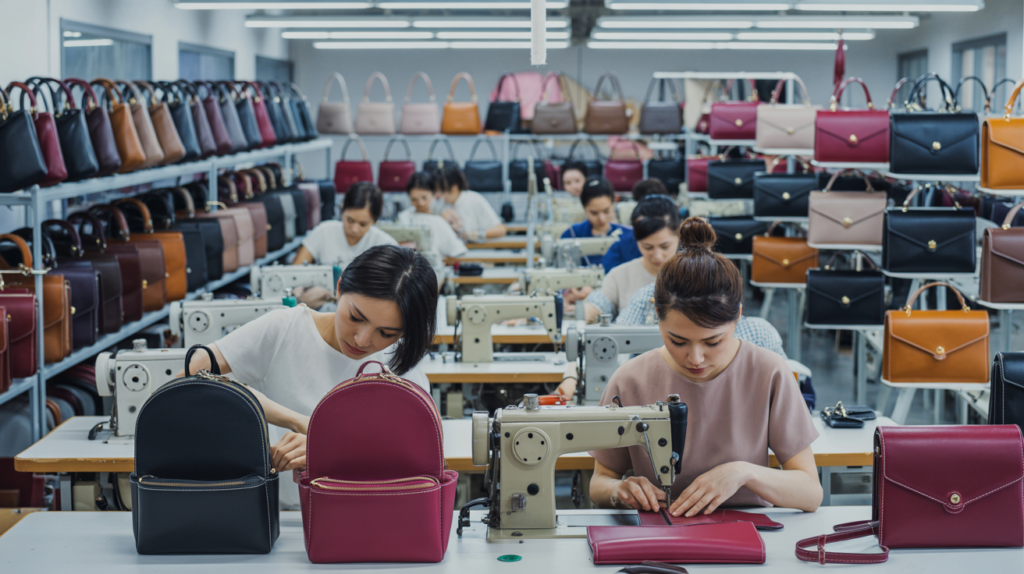
– Skilled assembly lines: Highly trained sewing teams, with specialty operators for thick leather and multilayer assembly, maintain production throughput while preserving artisanal details.
– Digital systems: Manufacturing Resource Planning (MRP) and Production Execution Systems (MES) track work orders, monitor bottlenecks, and provide transparency for clients.
By leveraging these technologies, PrinceBag delivers consistent quality at scale, while allowing for complex design details that elevate brand collections.
End-to-End Supply Chain and Vertical Integration
Global brands prefer partners who can reduce supply chain complexity. PrinceBag’s model minimizes risk and shortens lead-times through vertical integration and trusted supplier networks.
– In-house capabilities: Where feasible, PrinceBag brings components like cutting, lining, and assembly in-house to shorten cycles and control quality.
– Strategic supplier relationships: For tanneries, zippers, and decorative hardware, PrinceBag maintains long-term partnerships that ensure priority capacity and predictable pricing.
– Logistics and warehousing: Consolidated shipping, bonded warehousing for inventory management, and partnerships with global freight forwarders reduce customs friction and expedite delivery.
– Contingency planning: Multiple sourcing options for critical components and secondary production lines mean orders aren’t stalled by single-point failures.
This integrated approach helps global brands maintain consistent product launches across regions and allows more effective inventory planning.
Design Support, Sampling, and Rapid Prototyping
Brands need manufacturers who can translate creative concepts into manufacturable products quickly and accurately.
– Technical design: PrinceBag’s tech pack review, pattern-making, grading, and marker planning turn aesthetic sketches into production-ready patterns, often improving manufacturability without compromising design intent.
– Rapid sampling: Fast turnaround for initial samples — enabled by prototyping teams, 3D printing for hardware concepts, and digital mock-ups — accelerates decision-making cycles for seasonal ranges.
– Iterative feedback: Clear sample reports (with photos, measurements, and issue lists) help brands approve pre-production samples with confidence, reducing costly revisions during bulk production.
– Co-development: For private labels or exclusive collections, PrinceBag collaborates with client designers on material selection, trim innovation, and cost-effective reinterpretations of premium details.
These capabilities reduce time-to-market and help brands iterate faster within tight seasonal calendars.
Scalability and On-time Delivery for Global Brands
Scale, while maintaining quality and timing, is critical when a brand moves from boutique to mass distribution.
– Flexible capacity: PrinceBag structures production capacity to handle small-batch luxury lines and large-run wholesale orders, switching floor allocations and staffing to match seasonality.
– Forecasting and planning: Collaborative forecasting and shared visibility tools allow production schedules to anticipate peaks and allocate resources proactively.
– Lead-time management: Standardized lead-time matrices for different product categories help brands plan launches and marketing campaigns reliably.
– Logistics coordination: End-to-end route planning and multimodal shipping options (air for urgency, sea for cost efficiency) support varied go-to-market strategies.
On-time delivery is not an accident — it’s a function of planning, buffer management, and communication, all of which PrinceBag emphasizes for global clients.
Sustainability, Ethical Labor Practices, and Compliance
Sustainability and ethical manufacturing are central to many global brands’ values and compliance requirements.
– Environmental controls: PrinceBag implements responsible practices such as wastewater treatment, solvent capture, and controlled chemical use to comply with client and regulatory standards.
– Materials stewardship: Adoption of certified leathers, recycled textiles, and lower-impact synthetic materials addresses consumer demand and client sustainability targets.
– Social compliance: Transparent labor practices, living-wage initiatives, safe working conditions, and regular external audits reduce reputational risk. Many global brands require audit-ready factories; PrinceBag prepares documentation and corrective action plans proactively.
– Traceability: Supply-chain traceability programs and material declarations (e.g., restricted substances lists) provide reassurance that products meet retailer and regulatory requirements.
These measures help brands position products responsibly in markets where consumers scrutinize environmental and social practices.
Customization, Private Labeling, and Intellectual Property Protection
Brands expect their manufacturing partners to preserve design confidentiality and protect intellectual property.
– NDAs and IP agreements: Legal frameworks, secure data rooms, and strict on-site confidentiality policies ensure designs are protected.
– Tooling and molds ownership: Clear contractual delineation of tooling ownership and storage reduces later disputes and ensures repeat production access.
– Bespoke finishing: Custom hardware, signature stitching, and proprietary closures are produced under tight controls to preserve brand identity.
These protections let brands innovate confidently, knowing their unique design language is secure.
Quality Assurance: Inspection, Testing, and After-sales Support
A robust QA system distinguishes reliable manufacturers from risky ones.
– Inline inspections: Operators and line supervisors conduct real-time checks on critical assembly steps to catch defects early.
– Statistical quality control: AQL sampling, defect databases, and trend analysis detect systemic issues before they affect shipment quality.
– Third-party inspections: Independent agencies perform pre-shipment inspections and lab tests as required by clients to corroborate internal QA.
– After-sales feedback loop: Warranty management, root-cause analysis of returns, and corrective action plans close the loop and drive continuous improvement.
This systematic approach reduces returns, protects brand reputation, and lowers total cost of ownership for the client.
Client Collaboration & Communication: Multilingual Teams and Dedicated Account Management
Effective communication matters as much as manufacturing competence.
– Dedicated account teams: Single points of contact coordinate samples, approvals, production updates, and shipment logistics, reducing email overload and missed details.
– Multilingual capability: Teams fluent in English and other major languages bridge cultural and technical gaps for global clients.
– Transparent reporting: Weekly production dashboards, photo documentation, and exception alerts make project status visible and actionable.
– Design-for-manufacture consultations: Regular check-ins with design and sourcing teams ensure manufacturability and cost targets are aligned throughout development.
This collaborative model builds trust and reduces friction during hectic launch windows.
Cost Competitiveness and Value Engineering
Price competitiveness is expected, but smart cost management without compromising quality is what global brands need.
– Value engineering: PrinceBag proposes material substitutes, simplified constructions, and alternative hardware that preserve aesthetic and performance while lowering cost.
– Economies of scale: Volume discounts on materials and hardware translate into savings for clients with large or multi-season orders.
– Transparent costing: Detailed BOMs and cost breakdowns enable clients to understand cost drivers and make informed trade-offs.
– Total-cost focus: PrinceBag helps brands consider lifecycle costs — durability reduces returns; fewer reworks save time — shifting focus from unit price to total value.
This disciplined approach allows brands to protect margin and maintain product integrity.
Case Examples and Anonymized Success Stories
To illustrate how these capabilities translate into real outcomes, consider anonymized scenarios representative of typical global-brand engagements:
– Rapid seasonal ramp-up: A European fashion label needed to triple handbag output in 12 weeks. PrinceBag reallocated production lines, prioritized critical hardware suppliers, and reduced lead-time by 35% while maintaining AQL compliance.
– Quality rescue for a mass-retailer launch: A North American retail brand faced a high defect rate from another supplier. PrinceBag implemented a root-cause corrective program, tightened inline checks, and reduced defects by 80% in two production cycles.
– Sustainable capsule collection: A lifestyle brand wanted a recycled-material handbag line. PrinceBag sourced compliant textiles, adjusted construction techniques for new substrates, and met the client’s sustainability labeling requirements.
These examples reflect the practical outcomes brands seek from a trusted manufacturer: speed, quality improvement, and responsible innovation.
Analysis Table: How PrinceBag Performs Against Key Brand Requirements
| Criteria | PrinceBag Strengths | Business Impact / Evidence |
|---|---|---|
| Quality Control | Standardized IQC/FQC, AQL sampling, inline checks | Reduced defect rates; consistent pre-shipment acceptance; lower return costs |
| Manufacturing Technology | CAD/CNC cutting, laser/ultrasonic processing, MES integration | Precision components, lower material waste, repeatable quality |
| Supply Chain Integration | In-house assembly, vetted suppliers, bonded warehousing | Shorter lead-times, fewer delays, consolidated shipping |
| Design & Sampling | Rapid prototyping, tech-pack support, 3D mock-ups | Faster approvals, fewer revisions, accelerated time-to-market |
| Compliance & Sustainability | Chemical management, wastewater controls, audit-readiness | Meets global retail requirements; supports brand ESG targets |
| Scalability | Flexible production lines, forecast-driven planning | Capacity for seasonal spikes; predictable launch execution |
| Communication | Dedicated account teams, transparent reporting | Improved coordination; fewer miscommunications and delays |
| Cost Management | Value engineering, volume sourcing | Lower total cost of ownership; margin protection for brands |
| IP Protection | NDAs, secure tooling agreements | Design confidentiality; secure proprietary elements |
A Practical Checklist for Brands Considering PrinceBag
When evaluating PrinceBag or any manufacturing partner, global brands should verify the following:
– Production capability: Can the factory meet the required volumes and complexity?
– Quality systems: Are there documented SOPs, inspection protocols, and historical defect metrics?
– Compliance: Is the facility audit-ready for social and environmental standards?
– Lead times: Are development, sampling, and production lead-times acceptable?
– Traceability: Can the supplier provide material declarations and supplier traceability?
– Cost transparency: Are BOMs and cost sheets detailed and auditable?
– IP and legal protection: Are NDAs, tooling ownership, and confidentiality measures in place?
– Communication: Is there a dedicated project manager and frequent status reporting?
– Contingency plans: Are alternative sourcing and capacity buffers identified?
– Sustainability credentials: Does the partner support the brand’s environmental commitments?
PrinceBag’s processes are designed to address these checkpoints proactively, which is why many global brands consider it a dependable partner.
How PrinceBag Differentiates from Competitors
Several strategic differentiators help PrinceBag stand out:
– Balanced integration: Unlike purely artisanal or fully commoditized suppliers, PrinceBag combines hand-finishing where it matters with technology for consistency.
– Client partnership model: Rather than transactional quoting, PrinceBag engages in cost engineering and seasonal planning with clients.
– Audit-readiness and transparency: Frequent documentation and openness in QA build trust during onboarding and repeated seasons.
– Rapid iteration capability: Brands requiring frequent design tweaks benefit from PrinceBag’s agile sample and prototyping workflows.
These factors reduce friction and increase predictability — attributes global brands prize when scaling product lines internationally.
Challenges and How PrinceBag Mitigates Them
No manufacturing partner is without challenges. Common industry issues — raw material volatility, shipping disruptions, and labor market shifts — are addressed through:
– Forward buying and hedging strategies for key materials to stabilize pricing.
– Multiple logistics routes and partnerships to mitigate shipping congestion.
– Ongoing training programs and incentives to maintain skilled operator pools.
– Investment in automation to reduce dependency on highly repetitive manual tasks while preserving craftsmanship for high-value goods.
These mitigations reflect proactive risk management rather than reactive crisis handling.
Why Global Brands Trust PrinceBag
Trust is earned through performance, transparency, and partnership. PrinceBag’s combination of robust quality systems, technology-enabled manufacturing, supply chain integration, sustainability focus, and open communication creates a reliable platform for global brands to execute product strategies. Whether the priority is launching a limited-edition luxury collection, scaling seasonal ranges, or meeting strict sustainability goals, PrinceBag’s operational model aligns with the complex demands of international retail.
For brands, the decision to select a manufacturing partner is as much about risk mitigation and collaboration as it is about unit costs. PrinceBag’s capabilities — from rigorous testing to agile prototyping and audit-ready compliance — address those needs comprehensively. That practical reliability, demonstrated across development cycles and production runs, is the core reason why many global brands consider PrinceBag a trusted handbag manufacturer.